


Flexo Printing Market to Reach $299.6 Billion by 2031: What the New Forecast Means for Corrugated Box Printers
After five years of almost flat value growth, Smithers' latest flexo study points to a 2.9% annual rebound - and to automation, not extra capacity, as the main thing converters are buying.
November 18, 2026 - The global flexographic printing market will grow from $260.1 billion in 2026 to $299.6 billion in 2031, a compound annual growth rate of 2.9% in value, with print volume rising 3.0% a year. The figures come from The Future of Flexographic Printing to 2031, published by the research and consulting group Smithers and reported by the Flexographic Technical Association (FTA) on November 13, 2026.
The forecast matters because of what came before it. Over the previous five years, flexo print value grew by just 0.4% a year while volume fell 1.0% a year - a period in which rising prices masked shrinking output. The new numbers describe something different: real, volume-led growth, with demand rising faster than price.
1. Corrugated and flexible packaging still carry the market
Two segments do most of the work. Corrugated board and flexible packaging together account for 77.1% of flexo print value and 73.2% of volume in 2026.
The corrugated curve is worth understanding before investing in new capacity. Demand peaked in 2021, when heavy consumer spending on packaged goods met an e-commerce boom, then fell through 2022–2023 as online shopping normalised. Smithers expects steady growth through 2031 - but corrugated volumes in Europe and North America will not return to their 2021 levels. Flexible packaging, by contrast, is growing in real terms in every region, although its value is lagging volume because prices have not kept up with inflation. Labels and folding cartons have held pace with inflation globally.
2. Asia Pacific is the growth engine
Asia Pacific is by far the largest and fastest-growing flexo market in the study, with demand rising across most packaging categories. Its corrugated market dipped only slightly after 2021 and recovered quickly. North America and Europe are described as sluggish, while other regions remain smaller and slow-growing.
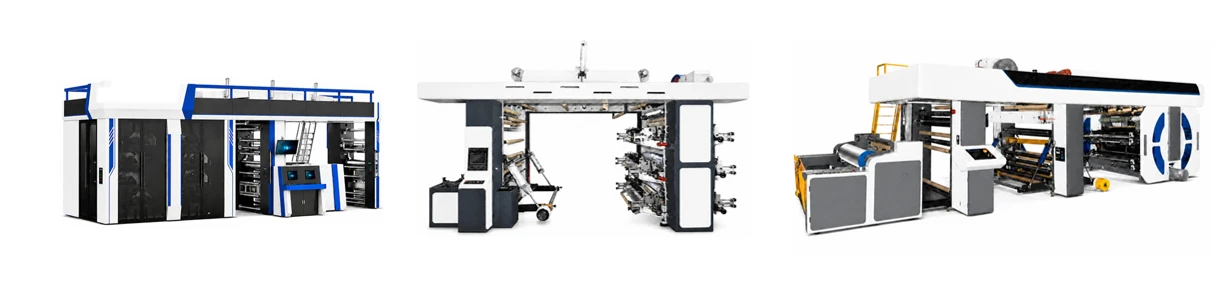
For packaging equipment buyers, that regional split has a practical consequence: new corrugated box flexo printing machine capacity is increasingly being ordered in Asia-Pacific and Latin America, where e-commerce and retail-ready packaging are still expanding, while mature markets concentrate on replacing older presses with more efficient ones.
3. Fewer presses, more output
One of the more counter-intuitive findings is that the number of flexo presses in operation is falling - in some cases sharply - even as new press sales stay buoyant. Faster, more efficient machines are replacing larger fleets of older equipment.
New sales are led by wide-web and medium-web configurations. Medium web is gaining as label and flexible packaging converters move into short-run flexible packaging; narrow web is declining, partly under pressure from digital presses, although hybrid label presses combining flexo and digital units are increasingly popular. Automation, often built around AI-assisted setup and control, is helping converters cope with skills shortages - a point the study returns to repeatedly.
Consumables tell a similar story. Flexo ink demand is outpacing print volume, because flexible packaging uses multiple colours at high coverage while much corrugated work is low-coverage and monochrome. Demand for plates and sleeves tracks volume more closely, and the 2022–2024 downturn in both is now reversing. Cost pressure has not gone away: conflict in the Middle East and oil shortages in parts of the world are pushing up raw material prices and creating shortages of some materials used in inks, plates and plastics.
4.A second view: press market to grow 3.2% a year to 2035
An IndexBox analysis updated on November 9, 2026 reaches a broadly similar conclusion from the equipment side, projecting a 3.2% CAGR in value for the flexographic printing press market to 2035. Its end-use split puts packaging printing at roughly 40% of global press demand, labels at 25% and corrugated board at 20%.
IndexBox also notes that wide-web flexo presses, including stack and in-line types, remain the standard for printing corrugated board, offering high throughput and the ability to handle large sheet sizes - demand that e-commerce and retail-ready packaging continue to push, particularly in Asia-Pacific and Latin America. On the sustainability side, the shift toward recyclable mono-material films and fibre-based solutions is expected to favour presses that can handle thinner substrates and run water-based or UV-curable inks.
The same analysis lists the constraints that converters know well: the capital cost of advanced presses, competition from digital printing on short runs, volatility in steel, aluminium and photopolymer prices, a shortage of skilled operators, and trade tensions affecting imported components.
5. What this means if you are buying a flexo printing machine in 2027
The forecasts point to a market where the money is made on uptime, waste and changeover speed rather than on maximum rated speed. A practical checklist before signing:
- Print width and board range versus your order book. A 2500 mm wide machine running at half width costs the same in power and labour as one running full width.
- Makeready and wash-up time. With run lengths shortening, setup time often decides whether a job is profitable, not running speed.
- Waste rate in the first 30 sheets. This is where a cheaper machine quietly loses money on short orders.
- Ink and substrate compatibility. Water-based and UV-curable systems are increasingly specified where recyclable board and film are involved.
- Automation that compensates for missing operators. Automatic feeding, pre-registration, motorised plate adjustment, and remote diagnostics matter more where experienced press operators are scarce.
- Service and spare parts response time. A press is only as good as the support behind it.
- Total cost of ownership. Power consumption, plate and anilox consumption, and downtime all belong in the comparison, not just the FOB price.


