
Gift Boxes Are Going Fold-Flat for PPWR - the Ribbon Pull Is the Hard Part
A rigid gift box is the most over-engineered object in packaging: 1,200 gsm greyboard, a wrapped paper shell, a magnet, a foam fitment, hot-melt glue and a satin pull. Europe now wants it recyclable at 70%, and the ribbon is the component nobody knows what to do with.
November 24, 2026 - For two decades the premium gift box has followed one direction of travel: heavier, thicker, more tactile. Drawer boxes with a ribbon pull, lid-and-base boxes with a magnetic snap, book-style cases with a foil-stamped spine. The format was designed to be kept, and the ribbon pull - the small loop of woven tape that lets a buyer slide a drawer open without a fingernail - became the signature of the category.
That direction has now reversed, and the reversal is being driven by a date rather than a design trend
1.What the regulation actually asks for
The EU's Packaging and Packaging Waste Regulation (PPWR) has been in force since February 2025 and applied from 12 August 2026. Its central obligation is that all packaging must be recyclable in an economically viable way by 2030; as the trade press summarises the design-for-recycling requirements, packaging will need a recyclability score of at least 70% by 2030, and grouped, transport and e-commerce packages will be capped at 50% empty space.
The scale of the problem is documented: the EU generated 186.5 kg of packaging waste per person in 2022, according to the European Commission.
Industry is not waiting for 2030 to react. In a survey of 200 UK businesses cited by Packaging Insights, 93% said the PPWR rules have already affected them or soon will; roughly 39% are in the middle of changing their packaging, and 16% have finished.
2.Why the rigid box is the exposed format
Most packaging is one material with a print on it. A rigid gift box is a stack of materials pretending to be one object:
- Greyboard - the structural core, dense and heavy
- Wrapped paper - the visible surface
- Magnet - in the closing flap of most premium boxes
- Foam or flocked insert - to hold the product
- Hot-melt adhesive - at every seam and every ribbon anchor
- Ribbon - usually a polyester or nylon satin weave
Recycling a box like this means separating all of it. A magnet in a paper stream is a contaminant; a foam fitment is a different polymer; and a woven polyester ribbon glued into the shell is, from a repulping line's point of view, a piece of textile hiding in a paper bale.
3.The fold-flat response - and what it changes for the ribbon
The most visible industry answer so far has been structural: fold-flat magnetic rigid boxes that ship flat and are erected at the packing station.
The numbers reported from the field are not marginal. Packshion's fold-flat magnetic design is claimed to cut storage and shipping space by up to 70% compared with pre-assembled rigid boxes. In one documented case, a retail skincare brand that switched from conventional pre-assembled rigid boxes reported a 60% reduction in packaging inventory space and a 20% decline in outbound international freight costs, with packaging-related feedback in product reviews up 15%.
For anyone making the ribbon end of the box, this is not a cosmetic change. A ribbon that was glued into a pre-assembled shell now has to survive being folded flat, shipped, unfolded and re-erected - repeatedly, sometimes after weeks in a warehouse. The failure mode moves: it is no longer "does the ribbon look straight on the sample" but "does the anchor still hold after the box has been flattened twice".
It also changes the ribbon's second job. On a fold-flat box, the brand mark is often printed on the ribbon itself, which means positioning accuracy becomes a branding issue, not just an assembly issue - a logo half a millimetre off centre is visible to every buyer who pulls the drawer open.
4.The material question nobody has settled
Three approaches are competing in the market, and none has won.
- Paper-based ribbon. Repulpable, mono-material with the box, and increasingly available in a ribbon weave. The trade-off is tensile strength and hand-feel: a paper ribbon does not drape like satin, and premium brands notice.
- Narrower, lighter textile ribbon. Less material per box improves the recyclability arithmetic without changing the look. It also reduces the anchor area, which puts more demand on the adhesive and the mechanical fixing.
- Mechanical anchoring instead of glue. Stitching, folding the ribbon through a punched slot, or trapping it under the wrap removes hot-melt from the ribbon joint. This is the approach that most directly addresses the recyclability score, because it removes a mixed-material joint rather than shrinking it.
What is missing across all three is a standard. There is no agreed test for "recyclable ribbon", and buyers are therefore asking suppliers for documentation that does not yet exist in comparable form.
5.What buyers are asking now
Conversations between brands, box makers and equipment suppliers have changed shape in the past year. Five questions recur:
- What is the recyclability score of the finished box, component by component - not the board, the box?
- Can the ribbon be separated by the end user without tools, and is that obvious enough that they will do it?
- Does the construction survive flat-shipping and re-erection without the ribbon anchor failing?
- Can the ribbon carry the brand mark accurately at production speed, or does that require a separate operation?
- Does the box still hit the 50% void-space cap with the insert fitted - or does the insert itself become the compliance problem?
The fifth question has caught out more than one project. Optimising the box and forgetting the fitment is a common way to fail a calculation that looks like it should pass.
6.The labour angle is not going away
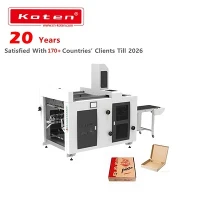
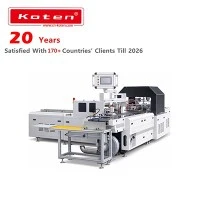
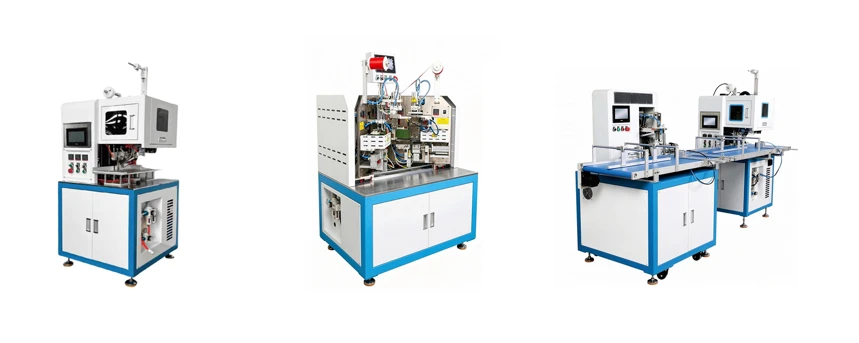
Ribbon insertion is one of the last hand operations in a rigid box plant: cut, fold, glue, position, press. It is slow, it is hard to staff, and it is exactly the kind of task that gets dropped when a shift cannot be filled. The data behind that pressure is now well documented - US manufacturing job openings reached 481,000 in June 2026, roughly 23% higher year on year, and PMMI's 2026 survey found 95% of end users struggling to find skilled operators and technicians.
Automating the step is therefore being driven by two forces at once: the compliance need to place a ribbon precisely and consistently, and the practical impossibility of staffing the operation by hand at holiday volumes.