
The Last Manual Step in Print Finishing: Bagging Machines Move Inline as Operator Shortages Hit 95% of Plants
A printing plant can now print, fold, stitch and trim without human hands - and then pay three people to put the finished cards into OPP bags. That gap is where the next round of capital spending is going.
November 24, 2026 - Walk the length of a modern print finishing line and you can count how many people are still necessary. Printing: automated. Folding: automated. Stitching and trimming: automated. Then the line stops. Product cards, instruction manuals, certificates, red envelopes, notebooks and hang tags are stacked, counted and fed by hand into plastic bags - a step that has resisted automation longer than any other in the plant, and one that is now colliding with two forces at once: a shortage of people willing to do it, and a regulatory environment that is starting to ask what the bag is made of.

1.The labour numbers have become an argument
Manufacturing job openings reached 481,000 in June 2026, roughly 23% higher year on year, while hiring stayed restrained, according to Bureau of Labor Statistics data reported by Manufacturing Dive and compiled by systems integrator System Technology Inc. in September 2026.
More pointed for equipment buyers: PMMI's 2026 report on AI in packaging equipment found that 95% of surveyed end users are struggling to find skilled operators and technicians. That is not a wage problem that a pay rise solves. It is a shortage of people who exist in the labour market at all - and bagging is precisely the job that gets abandoned first, because it is repetitive, hard to staff on a night shift, and produces no visible skill progression.
The investment response is measurable. North American robot orders in Q2 2026 were 8,940 units worth $622 million - up 4.3% in units and 21.3% in order value against the same quarter a year earlier, per A3 data reported by The Robot Report. Non-automotive customers accounted for 56% of unit orders, and food and consumer goods orders rose 17% year on year in the first half. PMMI and Interact Analysis size the US robotics market serving packaging and processing at above $440 million in 2025, heading for roughly $800 million by 2031 - a 10.3% compound annual growth rate - with 72% of end users already using robotics and 61% planning to increase investment in the coming year.
2.Why this step was left manual for so long
Bagging flat printed products is harder to automate than it looks, and the difficulty is physical rather than computational.
Finished print work is flat but not uniform: a stack of 200 gsm cards behaves nothing like a stack of thick manuals. Thickness varies within the same plant, and so does format - from business-card scale up to A4 certificates. A bagging machine therefore has to do four things at once: separate one item from a stack, hold it square, form a bag around it, and seal it, across a dimensional range that would defeat a fixed-format packer.
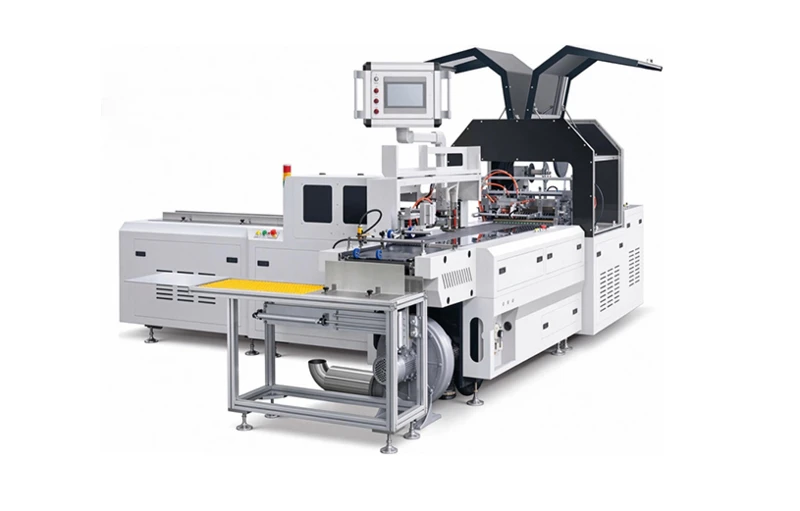
The design answer that has taken hold across the industry is to make the bag on the machine, from roll film, around the product. Instead of buying pre-made bags in dozens of sizes, the machine folds OPP film into a pocket, inserts the product, and heat-seals and cuts the bag to length. One machine then covers a size range that would previously have needed several bag SKUs and a great deal of shelf space.
3.The demand side is not standing still
Meanwhile the products being bagged have become more valuable, which raises the cost of a bad seal.
Collectr's mid-year 2026 hobby report - drawn from one of the largest behavioural datasets in the trading-card market - describes tracked sales volume more than doubling in 2025, with the first half of 2026 already delivering roughly three quarters of the previous year's full total, and notes that sealed product remains the hobby's strongest performing segment. Sealed mean packaged: a card product that reaches a buyer with a compromised seal loses value immediately, in a way that a scuffed manual does not.
The same logic applies less dramatically across manuals, certificates and branded stationery, where a crooked bag or a wandering seal reads as a quality failure at the point of sale.
4.Regulation is now part of the machine specification
Two regulatory clocks are running alongside the labour shortage, and both touch bagging.
In Europe, Regulation (EU) 2025/40 - the Packaging and Packaging Waste Regulation - applies from 12 August 2026, and requires all packaging to be recyclable in an economically viable way by 2030. The pressure it creates for a film-based operation is real: OPP is a plastic, and a bag that ends up in a paper recycling stream is a contaminant. Buyers are responding by asking machines to run thinner films, and to handle paper-based and mono-material alternatives without losing seal integrity - a demand that shows up in the specification sheet, not in the brochure.
5.What buyers are checking before they sign
The conversations have shifted from speed to economics per thousand pieces. Six questions now dominate:
- What is my size and thickness envelope - and does the machine's range cover the extremes, not the average?
- How many bags per roll change? Film roll diameter caps how long the machine runs unattended.
- What is the waste per start-up? Film consumed while sealing parameters stabilise is the hidden cost in a film-based line.
- Can it store recipes? A plant running forty SKUs needs size data recalled, not re-entered.
- Does it run the film I can actually buy - including thinner gauges and paper alternatives - at my altitude, humidity and shop temperature?
- What is the service response time, given that the machine sits at the end of a line where a stoppage idles everything upstream?
6.The bottom line
Print finishing automated everything except the part where the product becomes saleable. With 481,000 manufacturing openings unfilled in a single month, 95% of plants reporting they cannot find skilled operators, and packaging EPR arriving in the largest US state in January 2027, the economics of leaving that last step manual have stopped working. The equipment that replaces it is no longer exotic: it is a compact unit that sits at the end of a line, makes its own bags from roll film, and remembers a catalogue of formats. The question for most plants is no longer whether to automate the step, but how much capacity to bring in first.
Sources: System Technology Inc., "Automating a Packaging Line in 2026" (2 September 2026), citing Bureau of Labor Statistics data via Manufacturing Dive, PMMI's 2026 AI in packaging equipment report, PMMI/Interact Analysis robotics sizing and A3 robot order data via The Robot Report; Collectr, "State of the TCG Hobby: 2026 Mid-Year Report"; European Commission, Packaging waste and Regulation (EU) 2025/40.